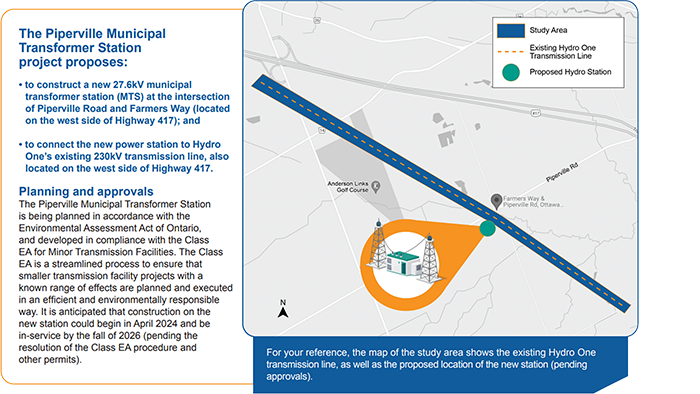
Piperville municipal transformer station
The Piperville municipal transformer station (MTS) in southeast Ottawa is a newly energized critical community asset designed to support the region's rapidly growing electrical demands. The station provides the massive electrical capacity required for local economic development, major transit electrification, and rapid residential expansion in the area.


Piperville MTS
Our first substation built with lower-carbon design.
Setting a new standard of excellence in the nation’s capital, the Piperville MTS proves that critical infrastructure can be sustainable.
Supporting major demand growth in southeast Ottawa, Piperville utilizes lower-carbon concrete, a reduced building footprint, and an optimized design to reduce the physical building’s on-site embodied carbon emissions.
Community engagement
Throughout the development process, comprehensive consultations were conducted with various stakeholders to ensure community alignment. This included hosting six information sessions, offered both virtually and in-person, to gather feedback and address local needs.
Lower-carbon design benchmark
The Piperville station establishes a repeatable, lower-carbon design benchmark for future substation infrastructure by focusing on reducing "embodied carbon emissions" which refer to the physical building’s greenhouse gas footprint generated from manufacturing materials and construction processes before the station is activated.
Embodied emissions explained
A lower-carbon design focuses specifically on embodied carbon, which represents the primary lifecycle emissions Hydro Ottawa can directly control as a utility through engineering and design choices—unlike operational or downstream emissions. As a first-of-its-kind proof of concept for the city, this design approach establishes a baseline for actionable innovation, with progressively greater reductions expected as new lower-carbon technologies emerge.
By utilizing progressive design and construction techniques, the Piperville project tracked environmental savings when compared against a baseline established by the previously constructed Cambrian municipal transformer station, which was energized in 2022.
Embodied emissions stem from three distinct areas: the physical building, the station yard, and the power equipment.
- Overall carbon reduction: The completed station achieved a 12.3 per cent reduction in embodied carbon emissions, eliminating approximately 618 tonnes of CO2e.
- Building emissions: Emissions generated from manufacturing materials like steel and concrete and constructing the main physical structures were reduced by 508 tonnes through optimized building design.
- Station yard emissions: The carbon footprint resulting from the massive exterior foundations required to safely support the heavy outdoor electrical equipment was reduced by 202 tonnes through the use of more sustainable raw materials.
- Power equipment emissions: The combined savings from the building and yard successfully off-set a 92-tonne increase in emissions associated with manufacturing and procuring the heavier, high-capacity electrical equipment needed to power community energy demands.
Enhancing grid resilience
As extreme weather events become more frequent, modernizing the grid is essential for long-term reliability. The Piperville station introduces vital network redundancy, safeguarding the local electricity grid against the impacts of severe weather disruptions. This ensures a consistent, resilient power supply that protects local homes and businesses, sustainably powering a future shared by all of us. Looking ahead, the station's modern infrastructure lays the foundation to integrate future clean energy innovations, including rooftop solar generation and battery energy storage systems, directly into the local grid.
Final environmental study report
January 29th, 2024
This Final Environmental Study Report describes the technical and environmental studies undertaken on behalf of Hydro Ottawa Limited for this project.