
Underground service trenches
Are you building or changing properties that need new or updated underground electricity from Hydro Ottawa? Proper underground trenching and installation are key to providing safe and reliable power. If you don’t follow these steps, it could lead to delays and safety risks — and even increase the costs of your project.


How to prepare your trench
Follow these steps to get your underground trench ready for electrical service:
Ask for a customer layout.
- Fill out our Service Request form to get a customer layout. This document shows all the details related to your power connection.
Confirm where underground cables are located.
- Before you dig, submit a request with Ontario Dig Authority to confirm where all the existing underground power lines are located in your work area.
- For more information, check out Ontario Dig Authority’s resources for contractors page and guide to reading a locate sheet.
Dig the trench.
- Once all the underground lines have been marked, you can dig the trench.
- Make sure the trench is the right width and depth. (For specifications, see UDS0003 or UDS0021.)
- Check that the trench walls slope correctly, as described in the Occupational Health and Safety Act.
- If your service connection is lateral to a pole, build the trench from the meter base to the pole. You’ll need straps, screws, a weatherhead and three pieces of conduit to complete this work. (For specifications, see UDS0023.)
Put in the duct and rope.
- After digging, place a DB2 duct (100 mm) in the trench. (For specifications, see to UDS0003.)
- Run a 9.65 mm diameter rope inside the DB2 duct.
Install meter base and conduit.
- Install a 200A king-size underground meter base. Use the size shown in your customer layout if it’s different.
- Install the correct size service conduit at the meter base.
- Extend the service conduit to 610 mm below grade. Then securely fasten the conduit to the wall 150 mm above grade.
Book the first inspection.
- Call our Service Desk at (613) 738−6418 to schedule the first inspection of your trench, duct and meter base setup.
Backfill after the first inspection.
Book the second inspection.
- After backfilling, call our Service Desk at (613) 738−6418 to book the second inspection.
Finish the final backfill.
- Once you’ve passed the second inspection, fill the rest of the trench to ground level with clean sand or backfill.
- Keep the areas at the meter base and splice pit ends open.
- If you own the cable, lay it and backfill the splice pit and meter base with clean sand. If a Hydro Ottawa contractor installed the cable, they will lay it and backfill the meter base to a minimum of 30 mm.
Get a connection permit.
- Get the required connection permit from the Electrical Safety Authority (ESA). You need this permit to get power.
Schedule a power connection.
- Call our Service Desk at (613) 738−6418 to set up a time for your service to be connected to power.
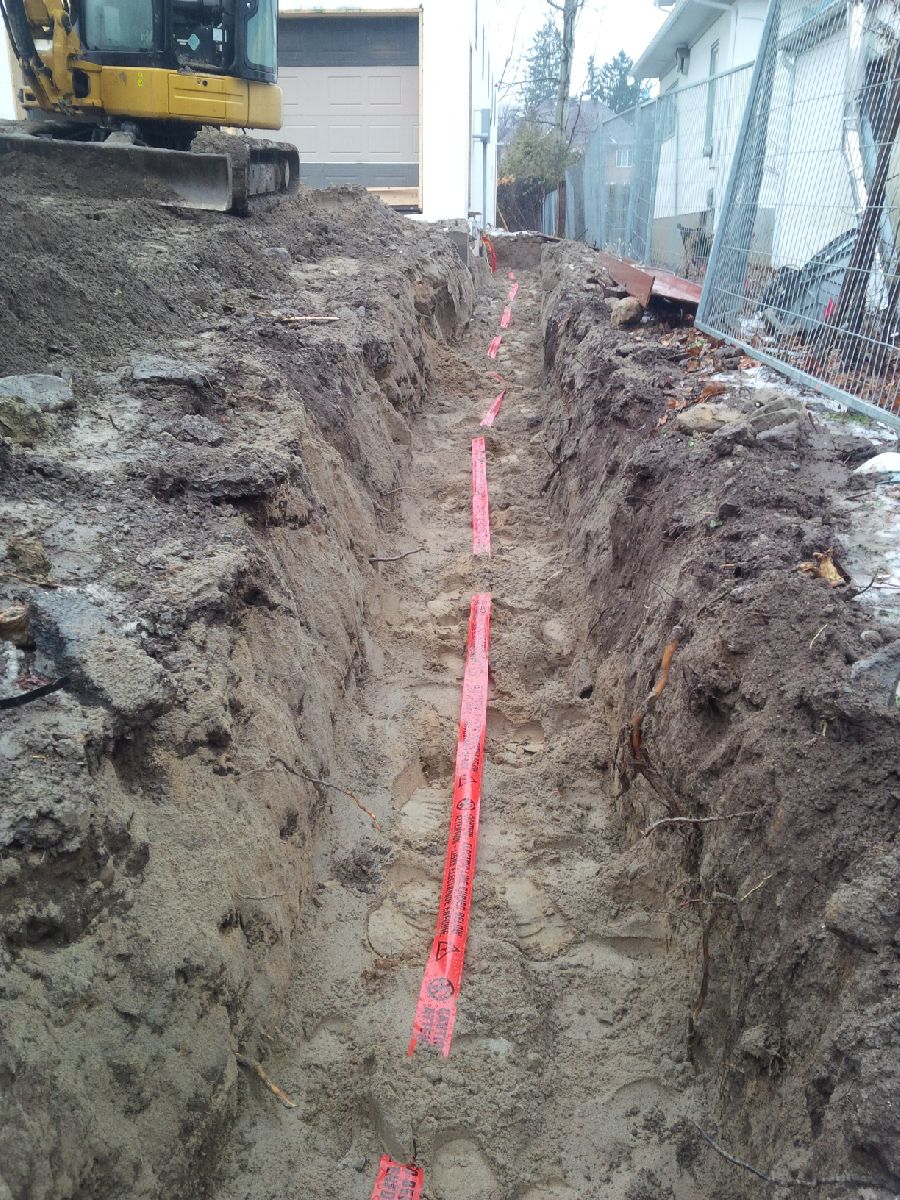
Examples of underground service trenches
The following photos show the correct way to build underground service trenches.




Questions?
Contact us if you need more information about underground service trenches.

