
From grid to grid: How provincial “loss of supply” impacts local power
July 28, 2026
When the lights go out, it’s natural to assume the problem is right on your street, like a fallen branch on a line or a damaged transformer. But sometimes, an outage occurs even when every piece of Hydro Ottawa infrastructure is in perfect working order. In the utility world, we call this a “loss of supply” from the provincial grid.

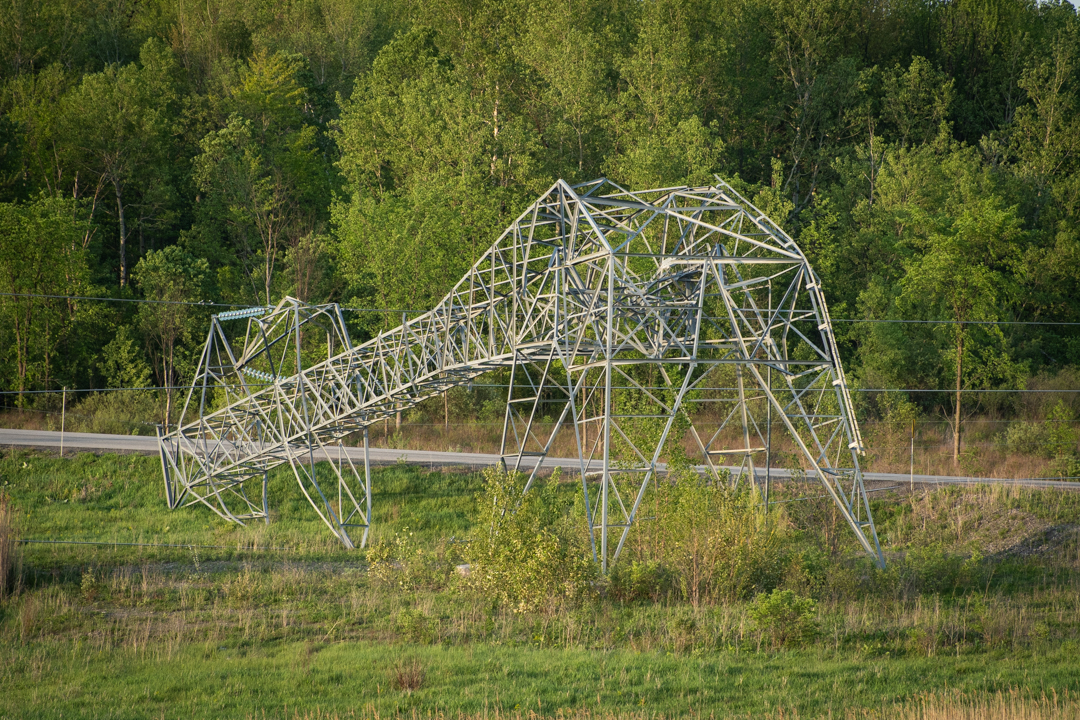
A provincial loss of supply refers to issues impacting the broader high-voltage transmission system, managed jointly by Hydro One Networks Inc. (Hydro One) and the Independent Electricity System Operator (IESO). When transmission lines fail or are damaged, a loss of supply occurs and local distribution companies (LDCs) like Hydro Ottawa cannot deliver electricity to your home or business through our distribution lines and transformers, causing sudden, widespread outages.
LDCs rely on the transmission system to deliver a majority of Ottawa’s power from the Ontario grid, however, if a problem with their system occurs, our customers can be affected, even though there’s nothing wrong on our end. Hydro One takes these outages very seriously and either reroutes supply or repairs their equipment swiftly, leading to very quick response times and, often, very short outages
Grid basics: how power moves across the grid
First, provincial generators like Ontario Power Generation (and private generation companies), produce electricity via various methods such as hydroelectricity, nuclear, solar, etc. at a relatively low voltage. But since electricity has a long distance to travel before arriving at its final destination, it must first go through a substation containing transformers to step-up the voltage (up to 500,000 volts).
It’s at this point that electricity reaches the transmission stage, where high-voltage power travels along transmission towers and lines across the province by organizations like Hydro One, the largest power transmission company in Ontario. These towers are designed to be tall and robust for safety reasons, keeping very dangerous electricity levels well above trees and human or animal interaction.
The high-voltage power levels become impractical once electricity draws closer to the neighbourhoods in which it will be consumed. As such, Hydro One delivers it through their transmission lines to local distributors — that’s us — who then reduce the high-voltage electricity (115,000-230,000 volts) safely through our municipal transformer stations which brings it down to a lower distribution voltage (up to 27.6 volts) and then delivers it to your door at 120-240 volts.
To learn more, check out our blog: A journey through the grid: from creation to you.
Questions and answers with our grid experts
We asked our system operation experts to answer some of the most common questions about provincial loss of supply and power restoration.
How do disruptions on the main provincial transmission system (like a downed tower or line) cascade down into the local grid and affect so many people?
Think of the electrical grid as a large funnel. As we learned in the grid journey above, high-voltage transmission lines sit at the very top of the electrical supply chain, feeding power to multiple municipal transformer substations at once. But when a main transmission line fails at the provincial level, it cuts off the primary feed to several substations simultaneously. Because all the local circuits downstream lose their source of power, tens of thousands of homes and businesses can go dark at once, even if local distribution infrastructure is fully intact.
How do sudden drops in provincial supply trigger critical cascading failures across other essential services, such as water pressure and telecommunications? What are some other areas that could be impacted?
Crucial community services like water plants, cell towers and traffic lights all depend on electricity to run. While most critical infrastructure has emergency backup, widespread power failures push these systems to their limits:
- Water treatment: Water plants and pumping stations require massive power to maintain city-wide water pressure. While they are equipped with large backup generators, a sudden grid failure can cause temporary pressure drops before they kick in.
- Telecommunications: Cell towers and internet hubs rely on backup batteries during an outage. However, these batteries typically last only a few hours. If the outage is prolonged, towers go offline one by one, disrupting cellular data, internet and emergency communications.
- Traffic and transportation: Most traffic lights instantly go dark during a power failure. When this happens, it’s important to treat intersections as four-way stops. The resulting gridlock can severely delay emergency vehicles and impact electrified transit systems.
What strategies has Hydro Ottawa implemented to isolate the impacts of a provincial supply loss so that entire neighbourhoods don't go dark at once?
Whenever an outage strikes, Hydro Ottawa system operators immediately look to supply customers through alternate sources. For localized issues, we can easily reroute electricity around the power fault, keeping adjacent neighbourhoods bright. This is possible because our distribution systems are designed and configured with built-in redundancies. Interconnections, known as tie-lines, link neighbouring circuits together. If one circuit is impacted by loss of supply, these ties allow us to switch power over to separate distribution circuits which are supplied by other working substations or transmission lines. However, our ability to utilize these backup options depends heavily on the scale of the disruption, since alternative power channels may lose supply too. In these cases, restoration is a coordinated team effort. Hydro Ottawa operators and field crews work directly with Hydro One and the IESO to safely isolate faults and restore power as supply returns.
If the provincial loss of supply to our distribution system is expected to last for a longer period of time, grid restoration across Ontario is guided by the Ontario Power System Restoration Plan (OPSRP). Under this framework, the IESO directs all provincial generators, transmitters, and distributors on how to safely bring power back online in stages as capacity returns to the main grid. Under the direct instruction of the IESO, Hydro Ottawa systematically restores power to our customers in stages as capacity is brought back onto the provincial grid.
How do weather events, such as the heavy storms and flooding often seen in the Ottawa area, affect above-ground local power lines compared to the provincial transmission network?
Local distribution lines are more vulnerable to adverse weather. High winds, freezing rain and ice storms can easily snap branches or uproot entire trees into overhead wires. Similarly, heavy rains and localized flooding can erode soil around wooden poles or damage ground-level and underground electrical infrastructure. The transmission network is heavily isolated from those same threats, though on the rare occasion that equipment fails or a severe enough storm actually downs a massive transmission tower, the resulting impact is much more widespread
While Hydro Ottawa works year-round on tree trimming, these lines ultimately run right through residential neighbourhoods, alongside streets and close to private property, meaning the potential for tree-related obstructions and localized damage is always present.
In contrast, the provincial transmission network is heavily isolated from those same local hazards:
- Dedicated corridors: Transmission lines run through wide, expansive "right-of-way" corridors kept completely clear of tall trees, significantly reducing the risk of falling branches.
- Heavy-duty infrastructure: Steel transmission towers and heavy-duty wires are engineered to endure extreme environmental stress, including severe wind shear, heavy ice loads and rising floodwaters, far beyond what standard wooden poles can handle.
- Built-in redundancies: The provincial high-voltage grid features multiple alternate paths, allowing power to be automatically redirected if a specific line is threatened.
Because of this, local distribution outages tend to happen more frequently but are much smaller in scale, typically affecting individual streets or neighbourhoods. Transmission outages, by comparison, occur far less often, but their impact is significantly larger, often affecting tens of thousands of customers across entire sections of the city all at once.
If the provincial supply is interrupted, what are the physical limits of our local grid when forced to operate on "island mode"? For instance, is Hydro Ottawa able to be self-sustaining for a limited time while repairs are made? What are our options? (re-route power, use local Distributed Energy Resources (DERs) like batteries and solar, etc.)
The short answer is no, not right now. Hydro Ottawa’s local grid relies almost entirely on the continuous high-voltage supply we receive from the provincial transmission grid, so if that primary supply cuts out, we cannot currently operate independently in "island mode" to sustain the city during a major provincial supply loss.
While customer-installed Distributed Energy Resources (DERs) — such as home battery systems — can reliably supply localized backup power to individual homes or businesses during an interruption, the total amount of power currently generated by DERs across the city cannot supply the broader grid during a loss of supply. There simply is not enough localized generation to meet Ottawa's massive peak demand. Instead, where DERs are most useful today is during periods of high electricity usage, helping to shave off peak demand load and ease strain on the system. Additionally, standard solar panel systems are engineered to automatically shut down during blackouts as a crucial safety feature, preventing electricity from feeding back into power lines where utility crews are actively working.
Luckily, a transmission outage does not automatically mean a total city-wide blackout. Except for rare, historic grid-wide disasters (like the 2003 Blackout), most transmission interruptions are isolated to single circuits. While a circuit failure may affect multiple Hydro Ottawa substations, our grid configuration often allows us to safely re-route power around the faulted zone and supply impacted customers from alternate, functioning stations.
Looking ahead, initiatives like Hydro Ottawa's GridFlex program (that rewards eligible customers for shifting electricity use during periods of high demand) and the shift toward a Distribution System Operator model (in which local markets, generation and demand response programs are managed at the distribution level) are laying the foundation for greater local grid flexibility and resilience in the future.
How do planned voltage reduction tests conducted by the IESO help prevent catastrophic grid failures during times of peak provincial demand?
Every year, Hydro Ottawa participates in a mandatory, province-wide three per cent and five per cent voltage reduction test. Led by the IESO, which is responsible for the overall reliability of Ontario's electrical grid, these tests are an actual live exercise — not a simulation.
This coordinated testing is governed by the OPSRP, which as explained above, outlines how the IESO and market participants like Hydro Ottawa must act during a system crisis, serving as a critical emergency readiness measure to ensure we can collectively prevent widespread blackouts during a major grid emergency.
To keep the provincial grid stable, the supply of electricity must always match customer demand, maintaining a constant frequency of 60 hertz. If a major provincial generator or high-voltage transmission line suddenly fails, supply drops, causing the grid's frequency to plunge. If frequency falls too low, other generators will automatically shut down to protect themselves, triggering a widespread blackout.
To prevent this collapse, the IESO orders a controlled voltage reduction. Hydro Ottawa executes this directly at our local municipal transformer stations, using station equipment to slightly lower the voltage flowing into our distribution system.
Slightly lowering the voltage at our stations instantly reduces total electricity demand across Ontario by thousands of megawatts. Because the reduction is kept strictly within safe industry limits, everyday consumers experience little to no impact at home — your lights might dim slightly, but your appliances and electronics continue to run safely. By practicing these live tests annually, we ensure our stations and control room operators are ready to drop demand at a moment's notice to protect the provincial grid during a real emergency.
The bottom line: partnering for a resilient grid
A provincial loss of supply is a reminder of just how interconnected Ontario’s power system really is. While high-voltage transmission disruptions can cause sudden, widespread outages affecting tens of thousands of Ottawa residents at once, they are typically restored swiftly thanks to rapid coordination between Hydro Ottawa, Hydro One, and the IESO.
Meanwhile, Hydro Ottawa continues to invest in grid modernization, automated switching, and local energy flexibility to insulate our community from upstream disruptions wherever possible.
Stay informed and prepared
No matter the cause of an outage, whether it's a neighbourhood branch on a line or a high-voltage supply loss, we are committed to keeping you informed and restoring your power safely and as quickly as possible.
- Check current outages: View our outage map for real-time updates and estimated time of restoration (ETR).
- Be storm-ready: Simple steps can make any power interruption easier to navigate. Visit our Outage preparedness webpage to download an emergency checklist for your home or business.