
Hydro Road municipal transformer station
May 2024 - December 2027
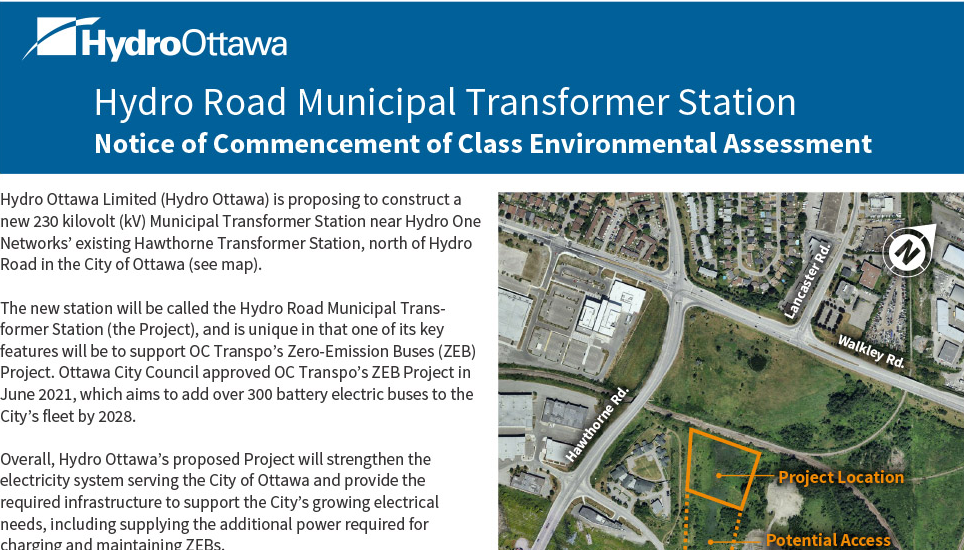
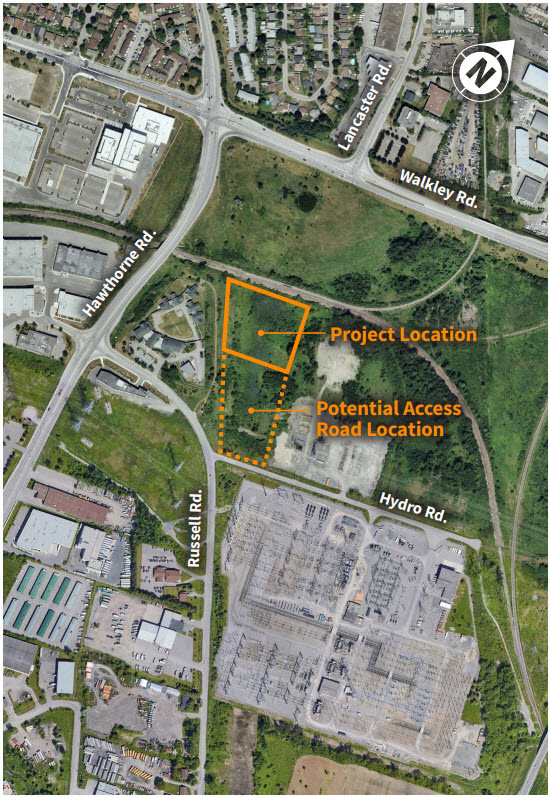
Hydro Ottawa Limited (Hydro Ottawa) is proposing to construct a new 230 kilovolt (kV) Municipal Transformer Station near Hydro One Networks’ existing Hawthorne Transformer Station, north of Hydro Road in the city of Ottawa.
What will this project include?
The Hydro Road Municipal Transformer Station project includes:
- The construction of a new 230 kV Municipal Transformer Station, that would be owned and operated by Hydro Ottawa, and located within Hydro One’s property with restricted access and 24/7 security personnel.
- The construction of new steel towers that will accommodate two new 230 kV overhead power lines that will connect the new transformer station to Hydro One’s existing Hawthorne Transformer Station.
The proposed project is subject to the Class Environmental Assessment (EA) for Transmission Facilities (Hydro One, 2024), in accordance with the Ontario Environmental Assessment Act (https://www.hydroone.com/about/corporate-information/major-projects/class-environmental-assessment).
The Class EA for Transmission Facilities is a streamlined planning process that has proven effective for minor transmission projects that have a predictable range of effects and have feasible environmental mitigation and/or protection measures in place. The Class EA process contains screening provisions that may apply to the proposed undertaking.
Why we are moving forward with this project
The new station will be called the Hydro Road Municipal Transformer Station, and is unique in that one of its key features will be to support OC Transpo’s Zero-Emission Buses (ZEB) Project. Ottawa City Council approved OC Transpo’s ZEB Project in June 2021, which aims to add over 300 battery electric buses to the City’s fleet by 2028.
Overall, Hydro Ottawa’s proposed project will strengthen the electricity system serving the city of Ottawa and provide the required infrastructure to support the city’s growing electrical needs, including supplying the additional power required for charging and maintaining ZEBs.
Contingent on the outcome of the Class EA, construction is anticipated to begin in 2025, with commissioning occurring in 2027.
FAQs
A municipal transformer station (MTS) “steps down” the voltage of the electricity being delivered by a high-voltage transmission line to a lower voltage that is suitable for distribution to local customers. Distribution lines are generally on wood poles along the road allowance, and may also be underground in some areas.
A reliable source of electricity is essential to supporting community growth - powering homes, schools, businesses, hospitals and transportation. Overall, Hydro Ottawa’s proposed project will strengthen the electricity system serving the city of Ottawa and provide the required infrastructure to support the city’s growing electrical needs, including supplying the additional power required for charging and maintaining ZEBs.
Yes. As a utility, we plan decades ahead and consider Ottawa’s unique electricity needs, including strengthening our own distribution network and infrastructure. We also look at new opportunities and innovative technology like distributed energy resources that can help build redundancy.
From a climate and planning standpoint, Hydro Ottawa considers recent years and events that point towards a new reality requiring contingencies to better protect the electricity grid, our systems and our customers. As such, we are investing in the grid and new technology to mitigate risks.
Further consideration is also given to meeting greenhouse gas reduction targets set by various levels of governments (plus our own 2030 zero-emission goal), as well as a future of mass electrification.
We are spearheading a lot of future planning to make the electricity system as clean, sustainable, and resilient as possible.
In 2023, Hydro Ottawa customers had power an average of 99.921 per cent of the time (99.548 per cent in 2022).
A Class Environmental Assessment (Class EA) takes a broad and all-encompassing view of the environment. Potential effects of the project will be examined through a number of detailed studies, taking into consideration factors relating to:
the natural and socio-economic environments; cultural/heritage resources; recreational resources; existing and planned land uses; visual landscapes; technical/cost considerations; and the concerns and interests of local business and residential property owners, Indigenous communities, government agencies and other interested parties.
A number of natural environment field studies will be undertaken in the project area as part of the Class EA process. This will include:
Species at Risk (SAR) surveys, as required by government agencies; Ecological Land Classification; botanical and tree surveys; aquatic habitat assessments; incidental wildlife observations; and, potential significant wildlife habitat mapping. Where effects on the natural environment cannot be avoided, appropriate mitigation measures will be proposed.
Yes. As part of our sustainability commitments, Hydro Ottawa intends to develop Hydro Road as a lower-carbon substation.
We are doing this by deploying lower Global Warming Potential (GWP) materials and design approaches that were developed on our lower-carbon Piperville municipal transformer station project.
Electric and magnetic fields (EMFs) are invisible forces that surround all electrical appliances and equipment, power cords and wiring found in your home. This is the same for outdoor power lines and equipment operated by utility companies. These fields are at extremely low frequency. The field strength is strongest close to its source and fades rapidly as you move away from the source.
Hydro Ottawa defers to Health Canada on the issue of EMFs. Health Canada does not consider that any precautionary measures are needed regarding daily exposures to EMFs at extremely low frequencies.
There is no conclusive evidence of any harm caused by exposures at levels found in Canadian homes and schools, including those located just outside the boundaries of power line corridors.
Once the design for the new MTS is determined, Hydro Ottawa will be able to project how EMFs might change.
During the construction phase of the project, local residents may see various types and frequencies of construction traffic depending on the stage of the construction. That being said, there will not be a sustained long-term traffic impact associated with the Hydro Road project.
Once operational, traffic generated by the station will generally be limited to a monthly site visit by a technician since the station will be remotely monitored. During major weather events, required maintenance or other related system needs, the station may be visited more frequently depending on Hydro Ottawa’s need as part of our commitment to deliver safe, and reliable electricity to our customers.
Understanding that any construction activities can be very disruptive, we want to assure residents that all construction activities and any possible power interruptions will be scheduled and planned very carefully.
Further, to ensure the safety of the public and our crews as a result of the work required for this project, the majority of the work will be completed weekdays between 7:00 a.m. and 5:00 p.m., and in accordance with City of Ottawa noise by-law.
There are no power outages planned at this time. Plans are in place so that electricity service can be maintained during construction of the new facilities.
If there is a need for a planned power outage of more than four hours in duration, we provide our customers with as much notice as possible. This includes notifications by phone, text and/or email depending on the account contact information we have on file, as well as hand-delivered letters where applicable. We also post notices on the Scheduled service interruptions section of our website.