
Lower-carbon substations Designed for sustainability
Over the next five years, a new generation of substations built using lower-carbon design will quietly transform how our communities are powered.






Why we’re building with lower-carbon design
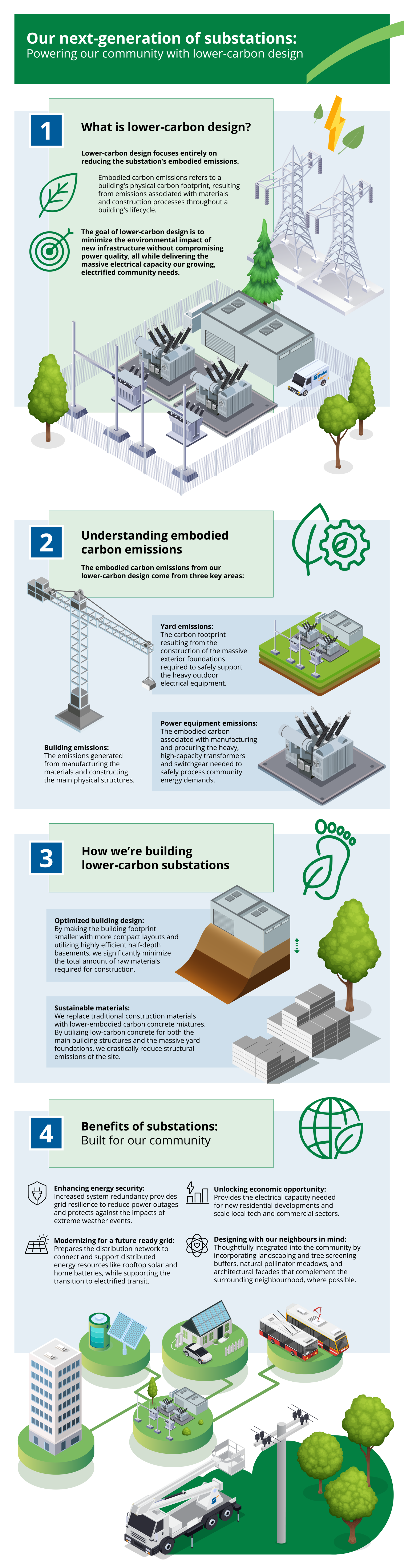
As part of building a more sustainable future, we’re developing all new major municipal transformer stations with lower-carbon designs. In addition to serving existing and new communities, the substations protect against weather-related events, and support new demand from the growing electrification of heating and transportation in our community.


Powering a growing city
Substations are an essential delivery checkpoint for electricity on the power grid while on its way to your home or business. They take high-voltage electricity supplied from the provincial grid and reduce it so it’s safe for you to use. As the region grows, this modern infrastructure is essential to keep pace with evolving energy needs. These investments unlock economic opportunity, bringing the capacity needed for new residential developments and expanding tech sectors.

Enhancing grid resilience
A smarter, stronger grid ensures the power stays on when it matters most. New substations provide enhanced system redundancy to protect against increasingly severe weather events, reducing the frequency of outages and ensuring faster restoration times. Building a resilient, future-ready grid supports the transition to electrification without compromising power quality.

Reducing our carbon footprint
The climate benefits of these new stations are achieved through a lower-carbon design standard that is focused entirely on reducing the substation's "embodied emissions,” the greenhouse gas footprint created from the materials and physical construction processes of the substation before it is even turned on. By utilizing sustainable materials like lower-carbon concrete and optimizing our engineering to build more compact layouts, we minimize the environmental impact of these investments.
How a lower-carbon substation works
Our lower-carbon substations
Until recently, Hydro Ottawa built a new substation every five to seven years. Today, to meet unprecedented electricity demands from new housing developments, expanding tech sectors, and the city's zero-emission public transit systems, we are on track to build and energize multiple stations every year through 2030.
Our lower-carbon projects are building the future of energy in Ottawa. These stations incorporate innovative design, procurement, and construction practices, including the use of lower-Global Warming Potential (GWP) materials and equipment to reduce embodied carbon throughout their construction.
As more advanced technologies and innovations emerge, we expect to achieve progressively greater emissions reductions.
Piperville municipal transformer station (2026)
Our first lower-carbon station began serving customers in the southeast region of Ottawa in September 2026. As our first proof of concept, Piperville has established a repeatable, lower-carbon design benchmark for Hydro Ottawa’s future substations.
Hydro Road municipal transformer station (2027)
This southeast station supports major grid capacity in the area, as well as Ottawa’s electrified, lower-carbon transit future, including the city’s zero-emission bus fleet of 350 electric buses.
Mer-Bleue municipal transformer station (2027)
This new 27.6 kV lower-carbon municipal transformer station will help to modernize the grid in east Ottawa, while meeting growing electricity demand and improving system resilience in Orléans.
Old Second Line municipal transformer station (2028)
This new municipal transformer station in Ottawa’s northwest region will increase power capacity for the Kanta North customers, its technology business hub, as well as its rural neighbour, West-Carleton March.
Greenbank municipal transformer station (2028)
This southwest station was undertaken to support a Government of Canada construction project. The station will be constructed within the National Capital Region greenbelt and will serve existing customers, while supporting projected growth in electricity demand for new residential and commercial developments in south Nepean for many years to come.
Curious about other grid upgrades in your neighbourhood? Visit our Major Projects page.


Service territory map of our new stations
From east to west - as our region grows upwards and outwards, we’ve been planning for new facilities with our partners at Hydro One Networks and the Independent Electricity System Operator through the 20-year Integrated Regional Resource Plan (IRRP) for the greater Ottawa area and municipality of Casselman. Explore our map of where the new lower-carbon stations will be located, as well as their service areas.
Piperville municipal transformer station
Our first substation built with lower-carbon design.
Setting a new standard of excellence in the nation’s capital, the Piperville MTS proves that critical infrastructure can be sustainable.
Supporting major demand growth in southeast Ottawa, Piperville utilizes lower-carbon concrete, a reduced building footprint, and an optimized design to reduce the physical building’s on-site embodied carbon emissions.